MaintainX is one of the best industrial CMMS platforms on the market — built for manufacturing, facilities, and fleet teams, deep on procedures and integrations, billed per user. FixGrid is residential-native for multifamily — apartments, residents, leases, and unit turns — billed per unit with unlimited seats. This isn’t mainly a price fight (MaintainX’s free and entry tiers can undercut FixGrid on raw seats). It’s a fit fight: if your assets are production lines, pick MaintainX. If your assets are apartments, residents, and turns, FixGrid is built for exactly that.
Quick comparison overview
FixGrid and MaintainX both call themselves a CMMS, but they sit in different worlds. MaintainX is a general-purpose industrial CMMS — it serves manufacturing plants, food and beverage, automotive, distribution centers, fleets, and facilities across dozens of industries. FixGrid is a residential-native CMMS — it does one thing: maintenance for multifamily apartment operators. The overlap is real (work orders, preventive maintenance, parts inventory, assets), but the assumptions underneath are completely different. MaintainX assumes equipment and crews. FixGrid assumes units, residents, leases, and turns.
| Dimension | FixGrid | MaintainX |
|---|---|---|
| Built for | Residential multifamily only | Industrial & facilities, many industries |
| Pricing model | Per unit ($49 base + $1.25/unit over 50) | Per user/seat |
| Seats / users | Unlimited — no per-user fee | Paid per full user; requesters free |
| Free tier | No free tier ($49/mo entry) | Yes — free Basic plan for small teams |
| Make-ready / unit turns | Full module (NTV → move-out → turn → QA → move-in) | Not a concept — no units or turns |
| Resident portal | Included in every plan — residents see the assigned technician and a live status | No resident or lease model; free requester accounts, and a no-login request portal (link or QR, email updates) on Premium |
| Residential compliance | Grid Apogee (NFPA 25 / EPA 608 / ASME / backflow), add-on on Professional | General industrial procedures & safety SOPs |
| Parts & inventory | Strong — per-property stock, POs, transfers, costing (Professional) | Strong — mature industrial inventory |
| Preventive maintenance | Templates → schedules → auto work orders | Recurring PM, procedures, deep on industrial assets |
| Procedures / SOP depth | Checklists & policy library (residential) | Deep digital procedures with conditional logic |
| Integrations | CSV exports with MITS-shaped columns; live PMS connector planned | Mature — API, SSO, ERP/IoT/sensor integrations |
| In-app messaging | Ticket activity & resident updates | Built-in team & work-order chat |
| AI | Grid Zenith property scoring (add-on), with narratives written by Anthropic’s Claude | MaintainX AI for industrial maintenance insights |
| Track record | Founded 2025; founder-led, residential-only | Founded 2018; large install base, multi-industry |
The pricing math at common operator sizes
The headline difference is the billing model: MaintainX charges per user; FixGrid charges per unit. That makes the comparison depend on how many maintenance users you have, not just how many doors. The table below assumes a maintenance team that scales with the portfolio (roughly one full user per 50 units — technicians plus a supervisor) and MaintainX’s Premium tier ($65/user/mo billed annually, $75 billed monthly, as of October 2026) — the tier where MaintainX’s full parts inventory, purchase orders, meter-based maintenance and full REST API begin, and so the closest match to FixGrid Professional’s parts and purchase orders:
| Portfolio size | FixGrid — Starter / Professional | MaintainX Premium (per user) | Difference |
|---|---|---|---|
| 50 units (2 users) | Starter $49.00 · Pro $99.00/mo | 2 × $65 = $130/mo | FixGrid lower — Starter $81 less, Pro $31 less |
| 100 units (3 users) | Starter $111.50 · Pro $199.00/mo | 3 × $65 = $195/mo | Starter $83.50 less; Pro about even ($4 more) |
| 250 units (6 users) | Starter $299.00 · Pro $499.00/mo | 6 × $65 = $390/mo | Starter $91 less; Pro ~1.3× ($109 more) |
| 500 units (10 users) | Starter $611.50 · Pro $999.00/mo | 10 × $65 = $650/mo | Starter $38.50 less; Pro ~1.5× ($349 more) |
Billed monthly, MaintainX Premium is $75/user, which puts the MaintainX column at $150, $225, $450 and $750. FixGrid figures are base plans: Grid Apogee (+$0.40/unit over 50) and Grid Zenith ($49/property/mo) are optional add-ons on Professional, and parts inventory requires Professional.
Now the honest part. MaintainX also has a free Basic tier and an Essential tier ($20/user/mo billed annually, $25 monthly). At Essential, a 100-unit operator with three users pays $60/month — less than FixGrid’s $111.50. So on raw seat cost, MaintainX’s entry tiers can undercut FixGrid, and for a tiny team the free plan costs nothing. I’m not going to hide that.
The catch is twofold. First, Essential includes recurring preventive work orders, but MaintainX’s full parts inventory, purchase orders, meter-based maintenance and full REST API start at Premium — so the closest match to FixGrid Professional is MaintainX Premium. On that basis FixGrid Professional costs less at 50 units ($99 vs $130/mo), the two run about even at 100 units ($199 vs $195), and MaintainX Premium comes in lower from there (about 1.3× at 250 units and 1.5× at 500) — the trade-off is that you’re comparing per-seat math against per-door math. FixGrid’s Starter tier costs less than MaintainX Premium at every size in the table, though Starter doesn’t include parts inventory. So price alone is competitive, not a blowout in either direction. Second, and more important: no MaintainX tier models the residential side. No units with leases. No make-ready turns. No resident record — requesters can submit work, but there’s no lease behind them. You’d be buying a well-built industrial tool and then doing all the residential work somewhere else. The price question only matters after the fit question, and on fit, an apartment operator and a factory need different software.
Where MaintainX wins
MaintainX is a category leader for a reason. If your maintenance lives outside residential, these are real, decisive advantages FixGrid does not try to match.
Where FixGrid wins
FixGrid is younger and narrower — on purpose. It does one thing an industrial CMMS structurally can’t: it understands apartments.
What about enterprise operators?
At enterprise scale the two rarely compete, because they serve different asset types — but here’s the honest framing for large operators.
MaintainX at enterprise: mature enterprise motion — SSO, advanced permissions, API, dedicated support, and large multi-site industrial deployments proven over years. If a large organization maintains a mix of facilities, equipment, and fleet alongside (or instead of) residential, MaintainX’s enterprise infrastructure is the stronger institutional choice.
FixGrid at enterprise: custom-proposal basis for multifamily portfolios above the public 2,500-unit ceiling, founder-direct rather than an enterprise sales team, with operational commitments matched to scale (written SLAs, dedicated success management, custom integration work with your PMS and accounting stack, and a documented security program, with SOC 2 Type II on our roadmap). Same residential-native software as the SMB tier. If you’re running 2,500+ residential units, talk to the founder directly.
Decision framework: which platform fits you?
Coming to FixGrid from an industrial CMMS
If you tried an industrial CMMS (MaintainX, UpKeep, or similar) for an apartment portfolio, hit the residential-fit wall, and went looking for something built for units and residents, here’s how the switch works:
- Export what you have. Assets, locations, vendors — whatever your current tool will give you, in any format (CSV, Excel, even screenshots).
- Send it to FixGrid with White-Glove Onboarding. We migrate your data, configure your properties and train your team for $0.50 per unit one-time ($149 minimum; included on Enterprise). No specific format is required, and there’s no setup fee.
- FixGrid maps it into a residential structure. Properties, units, asset registry and vendor contacts — restructured around buildings and units instead of a generic asset list. The timeline depends on the state of your data; we scope it with you.
- Founder walkthroughFounder setup call, then cut over. One call to confirm the migration and set up your team, then run in parallel briefly and switch. Monthly billing means no annual-contract overlap to absorb.
Frequently asked questions
Is FixGrid a MaintainX alternative?
For residential multifamily specifically, yes. MaintainX is a general-purpose industrial CMMS built for manufacturing, facilities, and fleet maintenance across many industries. FixGrid is residential-native — built only for multifamily apartments, residents, and unit turns. If you’re a multifamily operator who looked at MaintainX and felt like you were bending an industrial tool to fit apartments, FixGrid is the residential-native alternative. If you maintain production equipment or a mixed-industry asset base, MaintainX is the better fit and FixGrid is not an alternative for you.
What’s the real difference between MaintainX and FixGrid?
Two things: who they’re built for, and how they bill. MaintainX is built for industrial frontline teams (manufacturing, food and beverage, facilities, fleet) and bills per user — Basic is free; Essential is $20/user/mo and Premium $65/user/mo billed annually ($25 and $75 billed monthly); Enterprise is custom, as of October 2026. FixGrid is built for residential multifamily — units, leases, residents, make-ready turns — and bills per unit ($49 base + $1.25/unit over 50) with unlimited seats. MaintainX doesn’t model leases or unit turns; FixGrid isn’t built for a factory floor.
Is MaintainX cheaper than FixGrid?
It can be, on raw seat cost. MaintainX has a free Basic tier and an Essential tier ($20/user/mo billed annually), so a small team on a low tier can pay less per month than FixGrid — three users on Essential is $60/mo. But two honest caveats: the per-user model climbs as you add technicians, and MaintainX’s full parts inventory, purchase orders, meter-based maintenance, and full REST API start at its Premium tier ($65/user/mo billed annually); and no MaintainX tier models units, leases, or make-ready turns. On the closer match (MaintainX Premium vs FixGrid Professional), FixGrid costs less at 50 units, the two run about even at 100 units, and MaintainX Premium comes in lower as the portfolio grows; FixGrid’s Starter tier costs less than MaintainX Premium from 50 through 500 units. Price alone is competitive in both directions — but the deciding factor is residential fit.
Can MaintainX do make-ready turns and a resident portal?
Not in the residential sense. Make-ready (unit turns from notice-to-vacate through move-in) is a residential concept that an industrial CMMS like MaintainX doesn’t model. MaintainX does take requests from outside the team — free requester accounts on every plan and a no-login request portal on its Premium tier — but it is built around internal maintenance teams and assets, not leases and unit turns. FixGrid includes a full make-ready module and a resident portal where residents see the assigned technician’s first name and a live status with photos, because those are core to multifamily operations.
Does FixGrid track parts and inventory like MaintainX does?
Yes. Parts and inventory is one of the few areas where FixGrid and MaintainX overlap closely. FixGrid Professional offers a full parts catalog with per-property stock levels, reorder points, purchase orders and receiving, transfers between properties, cycle counts, weighted-average costing, and consumption tied to the work order — residential-native inventory depth comparable to what industrial CMMS tools are known for. MaintainX has mature, strong inventory as well; the difference is residential fit around it, not the inventory itself. See the parts & inventory deep-dive.
Which is better for compliance and inspections?
It depends on the compliance type. MaintainX is strong on general industrial procedures, safety SOPs, and audit documentation across industries. FixGrid is built for residential building compliance specifically — NFPA 25 fire pumps, EPA 608 refrigerant, ASME elevators, backflow preventers, generators — via Grid Apogee (an add-on on Professional), with scheduled due-date tickets and timestamped, attributed log exports for the inspector, framed for multifamily operators, lenders, and insurers. For an apartment portfolio’s regulated systems, FixGrid’s residential compliance framing is purpose-built; for plant-floor safety procedures, MaintainX’s is.
Which one should I pick?
Decide by asset type, not feature lists. If you maintain industrial or commercial assets — production lines, fleet vehicles, plants, facilities, or a mixed-industry portfolio — MaintainX is purpose-built and FixGrid is not for you. If you run residential multifamily — apartments, residents, leases, and unit turns — FixGrid is built for exactly that, bills per unit with unlimited seats, and was created by a 20-year multifamily maintenance professional. The tools rarely compete head-to-head because they serve different kinds of buildings.
Bottom line
MaintainX is the right answer for industrial and facilities maintenance — it’s mature, broad, deep on procedures and integrations, and proven across industries. FixGrid is the right answer for residential multifamily — it’s built around units, residents, and turns, bills per unit instead of per seat, and was made by someone who did the job for twenty years. The honest truth is they barely compete: pick by the kind of building you actually maintain.
Run residential multifamily and want to see software built for it? Try the live demoRequest demo access — no credit card, no sales call. Or read the honest comparison of the major platforms in 2026 to see how FixGrid and MaintainX fit alongside Property Meld, AppFolio, Buildium, Yardi Breeze, and DoorLoop. You can also compare FixGrid directly with Property Meld, AppFolio, and Buildium.
FMP

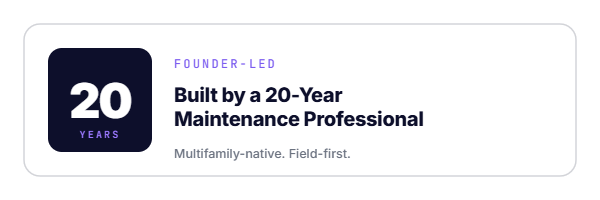
About the author: George Herlth is the founder of FixGrid and a 20-year multifamily maintenance professional with a Facility Management Professional (FMP) credential. Connect on LinkedIn.
Last updated: October 10, 2026. MaintainX pricing and feature claims are based on its published pricing and help documentation as of October 2026 (Basic free / Essential $20 / Premium $65 per user per month billed annually, $25 / $75 billed monthly, Enterprise custom) — pricing and features change, so verify current details on getmaintainx.com. If you spot an inaccuracy, email [email protected] and we’ll correct it.